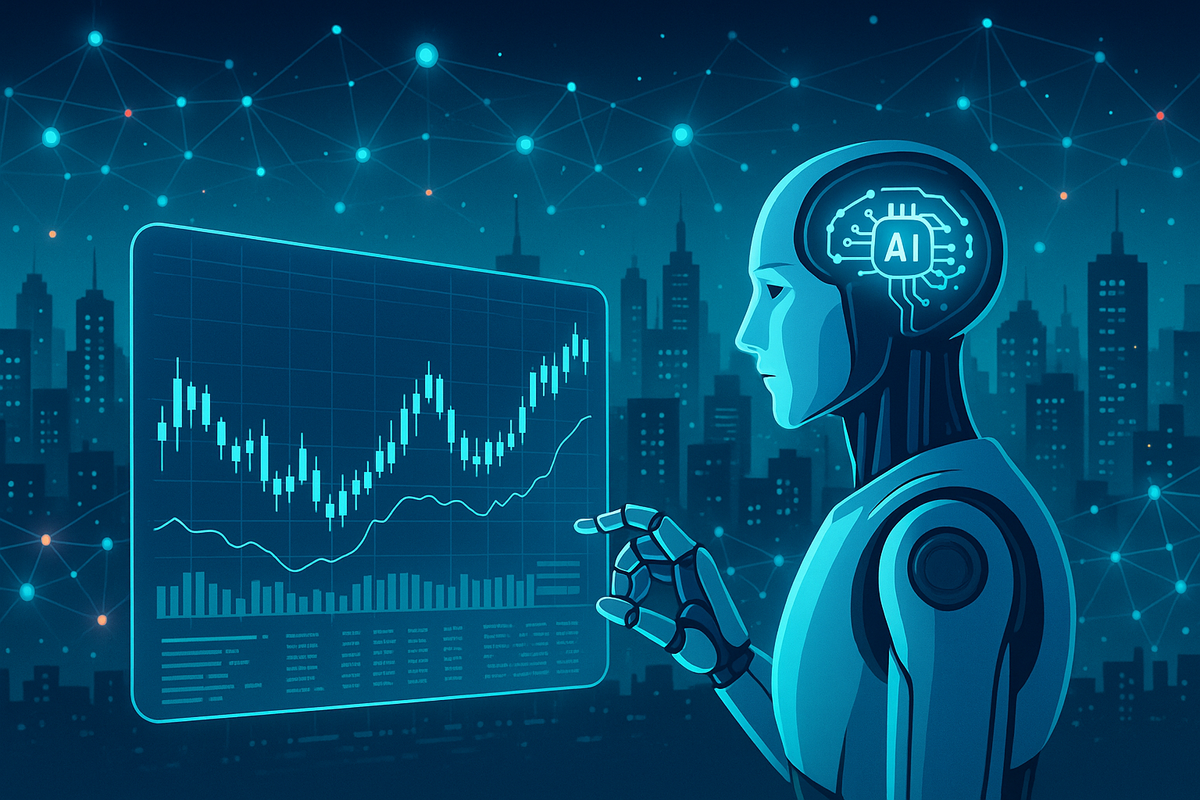
Digital Wealth Management and AI Driven Financial Strategy is the foundational pillar of modern capital preservation and growth. The shift from human-centric advisory models to automated, high-fidelity computational systems has fundamentally altered the landscape of global markets. By utilizing massive datasets, these systems identify patterns invisible to the human eye, ensuring that asset allocation is perpetually optimized against inflation, geopolitical instability, and market volatility. This methodology relies on machine learning algorithms that process millions of data points to execute trades at millisecond speeds, effectively eliminating the latency inherent in traditional financial decision-making.

The Integration of Generative AI in Personal Finance
The deployment of generative models in the financial sector has moved beyond simple chatbots to sophisticated decision-support systems. These entities analyze a user’s entire financial history, risk tolerance, and future goals to generate a bespoke investment roadmap. Unlike static portfolios, these AI-driven strategies are dynamic, adjusting to real-time macroeconomic indicators such as interest rate hikes or shifts in consumer price indices.
The core value lies in the elimination of cognitive bias. Human investors are prone to loss aversion and herd mentality; however, an AI-driven strategy operates on pure logic, executing contrarian trades when data signals overextension. By integrating natural language processing to scan global news, these systems can predict market movements based on political announcements before they are fully reflected in asset prices.
Decentralized Infrastructure and Tokenized Assets
The infrastructure supporting Digital Wealth Management and AI Driven Financial Strategy is increasingly moving toward decentralized ledgers. Tokenization allows for the conversion of physical assets—such as real estate, fine art, or rare commodities—into digital tokens on a blockchain. This process provides unprecedented liquidity to traditionally illiquid markets.
Investors can now own fractional shares of high-value commercial property, reducing the barrier to entry for wealth building. AI systems manage these tokens by monitoring smart contract execution for automated dividends. This decentralization removes the need for expensive intermediaries, ensuring that a higher percentage of returns remains with the investor. The convergence of AI and DeFi protocols creates a self-optimizing ecosystem where capital is always deployed in the highest-yielding, risk-adjusted environment.
Algorithmic Risk Management in Volatile Markets
Risk management in the digital age is no longer a reactive process but a predictive one. AI systems utilize Monte Carlo simulations to project thousands of potential market outcomes, allowing for the construction of portfolios that are resilient under extreme stress. This level of Digital Wealth Management and AI Driven Financial Strategy ensures that “black swan” events do not result in catastrophic capital loss.
The use of Value at Risk (VaR) models enhanced by deep learning allows for more precise calculations of potential losses during market downturns. Algorithms can trigger automated hedging through derivative instruments to offset spot market declines. This creates a “shock absorber” effect for the portfolio. By maintaining optimal diversification across non-correlated asset classes, the strategy minimizes systemic risk while capturing growth in emerging sectors.
Behavioral Analytics and Decision Architecture
Wealth management is as much about psychology as it is about mathematics. AI-driven platforms analyze user behavior to identify destructive financial habits. If a user displays a tendency toward panic selling during minor corrections, the system can implement automated cooling-off periods or forced diversification.
This decision architecture is built upon the principles of choice architecture to steer users toward positive outcomes. By presenting data in a way that emphasizes long-term compounding over short-term fluctuations, the AI helps build investor discipline. Advanced systems use biometric data and sentiment analysis to assess the investor’s emotional state, providing educational interventions when stress levels are high. This creates a symbiotic relationship between human goals and machine execution.
Regulatory Evolution and Algorithmic Compliance
The expansion of AI in finance has necessitated a new era of computational law and automated compliance. RegTech (Regulatory Technology) platforms now perform real-time audits of trading algorithms to ensure they do not engage in market manipulation or predatory practices. This layer of oversight is essential for the integrity of Digital Wealth Management and AI Driven Financial Strategy.
Compliance systems monitor for Anti-Money Laundering (AML) and Know Your Customer (KYC) violations using advanced pattern recognition. This automation allows financial institutions to scale their operations globally while adhering to the diverse regulatory requirements of different jurisdictions. The future of regulation is “embedded,” where the rules are written directly into the code of the financial protocols, ensuring that every transaction is compliant by design. This transparency builds the institutional trust necessary for mass adoption.
Quantitative Analysis of High-Frequency Trading
In the realm of Digital Wealth Management and AI Driven Financial Strategy, speed is a commodity. High-frequency trading (HFT) platforms use AI to exploit arbitrage opportunities across multiple global exchanges. These systems operate on a scale of microseconds, capitalizing on price discrepancies that exist for only a fraction of a second.
The mathematical complexity of these operations requires customized hardware such as FPGAs and ASICs to minimize latency. By participating in liquidity provisioning through market-making algorithms, these systems ensure that markets remain efficient. However, the concentration of power in these algorithms requires circuit breakers to prevent flash crashes. Modern strategies balance the aggression of HFT with the stability of quantitative long-term investing.
The Future of Sovereign Digital Currencies
The introduction of Central Bank Digital Currencies (CBDCs) will provide the final link in a fully digital financial strategy. Unlike traditional fiat, CBDCs are programmable money that can be integrated into AI workflows. This allows for the automation of tax payments, social transfers, and corporate payroll with zero friction.
Within a Digital Wealth Management and AI Driven Financial Strategy, CBDCs serve as the “settlement layer” that allows for instantaneous movement between cash and invested assets. This eliminates the 2-3 day settlement periods common in current equity markets. The data generated by CBDC transactions provides a high-definition view of the economy, enabling AI systems to adjust portfolios based on actual consumer spending patterns rather than delayed survey data.
Sustainable Finance and ESG Integration through AI
A critical component of modern strategy is the alignment of capital with Environmental, Social, and Governance (ESG) values. AI is the only tool capable of verifying corporate sustainability claims by analyzing satellite imagery, supply chain logs, and social media sentiment. This prevents “greenwashing” and ensures that impact investing actually achieves its intended goals.
By utilizing geospatial data to monitor carbon emissions, AI platforms provide an objective score for companies. Investors can then use automated filters to exclude non-compliant firms from their portfolios. This democratization of ethical investing ensures that wealth generation does not come at the expense of planetary health. The integration of climate risk modeling into financial planning is no longer optional; it is a fundamental requirement for long-term fiduciary duty.
Cyber Security and Asset Custody in the AI Era
As wealth becomes digital, the security of those assets becomes the paramount concern. Digital Wealth Management and AI Driven Financial Strategy incorporates AI-powered threat detection to prevent unauthorized access. These systems use behavioral biometrics to verify user identity based on typing speed, mouse movements, and gait.
Custody solutions have evolved into “cold storage” systems that use multi-party computation (MPC) to secure private keys. This ensures that there is no single point of failure. AI constantly monitors the network for signs of social engineering or phishing attacks, providing a proactive defense. In the event of a breach, automated recovery protocols can freeze assets and alert authorities in seconds. Protecting the digital perimeter of one’s wealth is the final, essential step in a modern financial strategy.
Conclusion: The Path Toward Autonomous Finance
The transition to an autonomous financial system is nearly complete. Digital Wealth Management and AI Driven Financial Strategy is the vehicle through which individuals and institutions will navigate the complexities of the 21st-century economy. By embracing the convergence of AI, blockchain, and big data, investors can achieve a level of precision and resilience that was previously impossible. The requirement for the modern investor is not to manage the assets personally, but to manage the algorithms that govern them. This shift marks the end of passive saving and the beginning of proactive, intelligent wealth orchestration.